
ROOT BARRIER
INSTALLATION
Tree roots don't stop at the property line or the sidewalk edge. They crack sprinkler pipe, tip heads out of alignment, fill valve boxes and lift concrete. We repair the damage roots have already done, then install a barrier that steers them down and away so the same problem doesn't return next season.
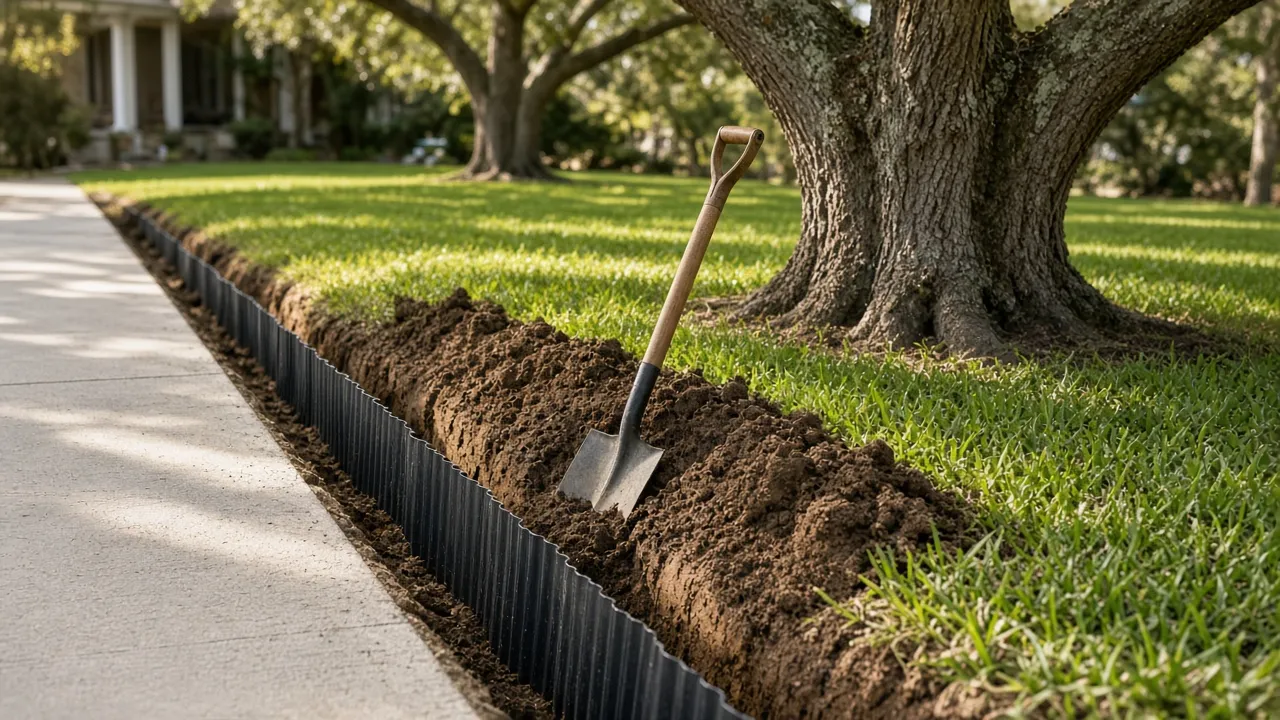
WHAT IS A ROOT BARRIER?
A root barrier is a physical panel set vertically in the soil between a tree (or a large, aggressive shrub) and whatever you need to protect: a sidewalk, driveway, pool deck, slab edge, or the sprinkler lines running under your lawn. Instead of cutting roots back again every few years, the barrier redirects new growth downward and away, so the tree keeps growing and your hardscape and irrigation stay put.
Roots are opportunistic. They grow where water, oxygen and loose soil are easiest to find, and in a watered Texas landscape that often means straight toward irrigation lines, valve boxes and the moist soil along walks and slabs. A root that starts out no thicker than a pencil can, over the years, get big enough to crush or crack PVC pipe, shove a sprinkler head sideways and lift a section of concrete.
We come at root problems from the irrigation side first. A lot of the root damage we find starts as a sprinkler complaint: a zone with weak pressure, a head that won't pop up, a wet spot that never dries out. We fix the damage, trace the roots responsible and, when it makes sense, install a barrier so you aren't paying for the same repair again next year.
Signs You May Need a Root Barrier
- Sidewalk, driveway or patio slabs lifting or cracking near a tree
- Sprinkler heads tilting, sinking or no longer popping up straight
- Repeat leaks or cracked pipe in the same part of the yard
- Low pressure in one zone after a nearby tree has matured
- Valve boxes pushed up, shifted or packed with roots
- Thick surface roots showing up in the lawn or beds
- A young tree planted close to a walk, slab or irrigation line
- Roots found wrapped around or inside a line during a past repair
HOW WE INSTALL A ROOT BARRIER
Every yard and every tree is different, so there's no one-size-fits-all layout. Here's how a typical root barrier job works from the first visit to cleanup.
Site Walk & Diagnosis
We look at the tree, its root zone and what's at risk: slabs, walks, the edge of the foundation, irrigation lines and valve boxes. If a sprinkler problem brought us out, we find and confirm the damaged section first so the repair and the barrier are planned together.
Locate Lines & Utilities
Before any digging we map the irrigation lines, valves and wiring on the property and request utility locates through Texas 811, so the trench path avoids buried gas, electric, cable and water service.
Plan the Barrier Line
We set the placement, length and depth based on the type of tree, how close it is to what you're protecting, your soil and access. As a rule we keep the barrier as far from the trunk as the space allows, which is better for the tree.
Trench & Clean Root Cuts
We cut a narrow trench along the planned line. Roots that cross it are cut cleanly instead of torn, which is easier on the tree. If a large structural root sits close to the trunk, we stop and talk with you. That's a job for an arborist's opinion before anything gets cut.
Set the Barrier Panels
Panels go in vertically with the ribs facing the tree and the top edge left just above finished grade so roots can't simply climb over. Seams are overlapped and joined, then the trench is backfilled and compacted in layers.
Repair, Restore & Test
Any pipe, heads, swing joints or valves the roots damaged get repaired or rerouted. We run the affected zones, check pressure and coverage, and restore the turf, mulch or bed edge we disturbed.
ROOT BARRIER OPTIONS WE USE
The right barrier depends on what you're protecting, the tree involved and how much room there is to work. These are the options we'll walk through with you.
Linear Barrier Panels
Rigid, ribbed plastic panels (typically HDPE or polypropylene) installed in a straight or gently curved run along a walk, driveway, slab or irrigation line. The vertical ribs steer roots downward instead of letting them circle along the panel.
Surround Installs for New Trees
When a tree is being planted in a tight spot like a parkway strip or a bed next to the drive, panels can go in around the planting area at planting time. That trains roots downward from the start, before they ever reach concrete or pipe.
Flexible Sheet Barriers
Flexible barrier material handles tight curves and awkward access where rigid panels won't fit. It's generally better at guiding finer roots than holding back large ones, so we'll tell you honestly when it's the right fit and when it isn't.
Line Sleeving & Rerouting
Sometimes the smartest fix is moving the irrigation instead of fighting the tree. We can reroute lateral lines around a root zone or run pipe through a protective sleeve where it has to pass close to a tree.
Drip Conversion Near Trees
Spray heads crowded against a trunk are a constant repair headache. Converting tree rings and nearby beds to drip irrigation puts water where plants need it, cuts overspray and removes heads that roots keep knocking out of line.
Follow-Up Checks
A barrier redirects roots; it doesn't make them disappear. When we're out for seasonal sprinkler service we can look at the barrier line, the heads nearby and any early signs of new root activity.
HOW TREE ROOTS DAMAGE SPRINKLER SYSTEMS
Irrigation lines sit in exactly the soil roots like best: shallow, loose and regularly watered. A slow leak at a fitting makes things worse. It creates a pocket of constantly wet soil, roots grow into it, and as those roots thicken they put more pressure on the fitting until a drip becomes a crack. By the time you see a soggy patch or a pressure drop, roots have often been working on that line for a long time.
Sprinkler heads take a beating too. Roots grow around risers and swing joints and slowly lift or tilt the head, so the spray pattern ends up hitting the fence, the street or the side of the house instead of the lawn. Some heads get pinched so they can't pop up at all. Valve boxes can fill with fine roots that wrap around wiring and make every future repair slower.
Watering habits matter as well. Short, frequent run times keep only the top few inches of soil moist, which encourages trees to root shallowly, right where your pipes and slabs are. Deeper, less frequent watering encourages deeper rooting. Part of our root barrier visit is checking your controller schedule and suggesting changes that work with the barrier instead of against it.
How We Fix the Irrigation Side
- Repair cracked lateral and main line sections found during the job
- Replace or reset tilted heads and add flexible swing joints
- Reroute lines out of the root zone where that's the better fix
- Convert tree rings and nearby beds to drip irrigation
- Adjust the controller for deeper, less frequent watering
- Check for hidden leaks that keep feeding roots moisture
A BARRIER THAT'S FAIR TO THE TREE, TOO
Mature trees add shade, value and character to a Texas property, and the goal is never to trade a cracked sidewalk for a sick tree. A well-placed barrier is set at a reasonable distance from the trunk and cuts only the roots that cross the line. We avoid cutting large structural roots near the trunk, and for large, mature or especially valuable trees we'll recommend you have a certified arborist look at the tree before we start.
It also helps to know what a barrier can't do. Roots will still grow, and some will eventually pass beneath the panel. That's expected: the point is to push them deeper, below the zone where they lift concrete and break shallow irrigation lines. A barrier is also not a foundation repair. If you're seeing signs of structural movement, talk to a foundation professional. We focus on the roots, the irrigation and the drainage around your home.
If the tree sits in a city parkway or a common area, it may belong to the city or your HOA, and they may have their own rules about root pruning and barriers. We're happy to plan the work around those requirements once you've checked with them.
ROOT BARRIER SERVICE ACROSS OUR TEXAS SERVICE AREAS
We install root barriers and repair root-damaged irrigation for homeowners and properties throughout our Texas service areas, including Dallas-Fort Worth and Houston Metro communities as well as the Austin and San Antonio areas. From the expansive clay common in North Texas to the heavy, often wet soils around Houston, we plan each barrier around the soil and tree species in front of us. See all the cities we serve or request service online.
ROOT BARRIER INSTALLATION FAQ
MORE WAYS WE PROTECT YOUR YARD
ROOTS CAUSING
PROBLEMS?
Lifted walks, tilted heads, the same leak again? Tell us what you're seeing and we'll set up a visit to find the roots and fix the damage.