
YARD DRAINAGE &
FLOODING SOLUTIONS
Standing water, soggy turf and runoff against the slab are more than an eyesore. We install French drains, catch basins, downspout and channel drains, and regrade problem areas so water has a planned path away from your home. Because we're irrigation specialists, we also check whether the sprinkler system is part of the problem.
WHAT OUR DRAINAGE SERVICE COVERS
Texas yards get their water in bursts. A dry stretch can be followed by a storm that drops more rain than clay soil can absorb, and whatever the ground can't take has to go somewhere: across the lawn, against the foundation, under the fence, into the garage or into a low spot that stays soggy for days. Drainage service is about giving that water a planned path off your property instead of letting it pick its own.
We design, install and repair French drains, catch basins and area drains, underground downspout drains, channel (trench) drains across hardscape, dry creek beds and swales, and grading or regrading so the ground sheds water away from the house. Most yards need a combination rather than a single product, and we'll explain why each piece is there.
We're an irrigation company first, and that shapes how we look at drainage. Before recommending a single foot of pipe, we answer the question many drainage jobs skip: is this really a drainage problem, or is the sprinkler system putting down more water than the yard can handle? Sometimes it's both. Knowing which saves you from paying to drain away water you shouldn't be applying in the first place.
Signs Your Yard Needs Drainage Work
- Standing water in the lawn for a day or more after rain
- Water pooling against the foundation, patio or driveway
- Soggy, spongy turf, moss or algae in low areas
- Mulch and soil washing out of beds after storms
- Downspouts dumping roof water right next to the slab
- Erosion channels or bare soil on slopes
- Water reaching the garage, back door threshold or crawlspace
- Low spots that never dry out and breed mosquitoes
HOW WE SOLVE DRAINAGE PROBLEMS
Good drainage work starts with understanding where the water comes from and where it can legally and practically go. This is how we approach every drainage job.
Watch Where Water Goes
We walk the property with you, look at slopes, low spots, downspouts, hardscape and neighboring lots, and ask when and where the water shows up. Photos or short videos you take during or after a storm are incredibly helpful here.
Rule Out the Sprinklers
We run your irrigation zones and check for weeping valves, broken lines, heads draining at low points and run times that oversaturate the soil. A spot that's wet on dry, sunny days usually points to the irrigation, not the weather.
Design the Water Path
We choose the right mix of French drains, catch basins, channel drains, downspout lines and grading, then plan the pipe route and slope to a suitable outlet. Irrigation lines are mapped and utility locates are requested through Texas 811 before we dig.
Install the System
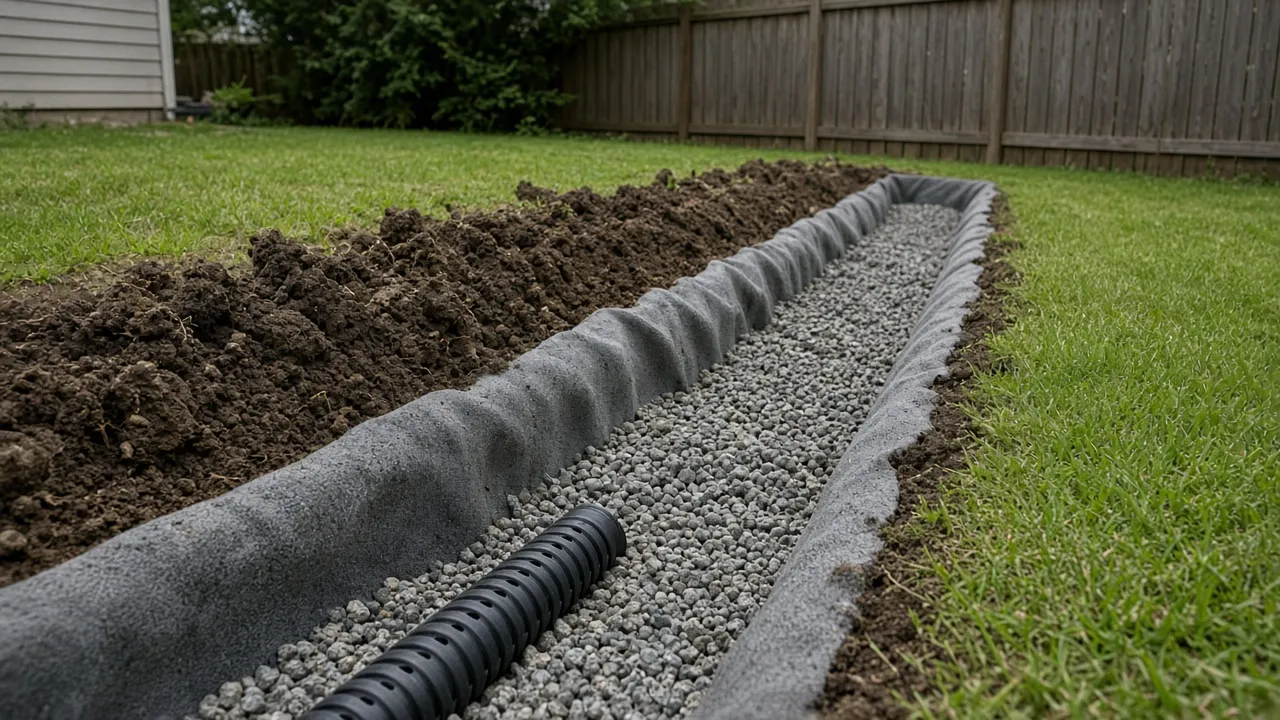
Trenches are cut to maintain steady fall toward the outlet. Depending on the design we install perforated or solid pipe, washed gravel, filter fabric, basins, grates, channel drains and pop-up emitters or curb outlets.
Grade & Restore
Soil is reshaped so the ground slopes away from the foundation and low spots are filled or turned into gentle swales. Any sprinkler lines we cross are repaired or rerouted, heads are adjusted, and turf and beds are restored.
Flow Test & Walkthrough
We run water through inlets and downspout connections to confirm it reaches the outlet, then walk you through the system: where the inlets and outlets are, and what to keep clear.
DRAINAGE SOLUTIONS WE INSTALL
Each drainage method handles a different kind of water problem. Here's what each one does and where it fits.
French Drains
A gravel-filled trench with perforated pipe, wrapped in filter fabric, that collects water from saturated soil and carries it to an outlet. French drains work well along side yards, the base of slopes and long soggy strips of lawn.
Catch Basins & Area Drains
Surface inlets set at the low points where water collects, connected to solid pipe that carries it away. Basins can be paired with downspouts and French drains, with grate styles that suit turf, beds or hardscape.
Downspout Drains
Roof runoff is one of the biggest sources of water near a foundation. We connect downspouts to underground solid pipe and move that water well away from the house to a pop-up emitter, curb outlet or other suitable discharge point.
Channel (Trench) Drains
Linear grated drains set across driveways, patios, pool decks and walkways where water sheets across the concrete toward the garage or the house. They catch it before it gets there and send it into the drain system.
Grading & Regrading
Sometimes the fix is the shape of the ground itself. We regrade soil so it slopes away from the foundation, fill low spots and create shallow swales that guide surface water around the house instead of toward it.
Dry Creek Beds & Swales
A rock-lined channel moves surface water across the yard and doubles as a landscape feature. It's a good choice where you need to carry a lot of runoff but would rather see stone than a grate.
IS IT A DRAINAGE PROBLEM OR YOUR SPRINKLERS?
Plenty of soggy yards aren't drainage problems at all. A valve that doesn't fully close lets water weep out of the lowest heads in the zone for hours. Heads at the bottom of a slope drain the whole line every time a cycle ends. A cracked lateral line can keep one area wet for weeks. Overlapping spray, run times set too long, extra start times programmed by accident, or a rain sensor that stopped working can all turn a lawn into a sponge. Install a French drain on top of any of those and you've just built an expensive way to hide wasted water.
The reverse is true as well: poor drainage makes an irrigation system harder to live with. Heads in saturated soil sink and tilt. Valve boxes in low spots fill with water and mud, making valves hard to service. Runoff on clay soil and slopes means water hits the street instead of the root zone. Fixing drainage and tuning the sprinklers together usually gives the best result.
How We Fix the Irrigation Side
- Check valves for weeping and repair or replace leaking ones
- Add check valves to heads at low points to stop low-head drainage
- Find and repair lateral and main line leaks
- Program cycle-and-soak schedules for clay soil and slopes
- Confirm the rain and freeze sensor is working
- Relocate or raise heads and valve boxes out of low spots
GETTING THE DISCHARGE RIGHT
Collecting water is only half the job. It has to end up somewhere appropriate, and that's where a lot of drainage projects go wrong. We plan outlets to the street or curb, an existing swale or another suitable discharge point, with enough fall along the way that the pipe actually empties instead of holding water.
Water shouldn't simply be pushed onto a neighbor's property, and many cities and HOAs have rules about curb cuts, discharge points and changes to grading. We design around those requirements and will point out anything you may need to confirm with your city or HOA before work begins.
Soil matters too. The dense clay common across much of Texas soaks up water slowly, so solutions that rely on water sinking into the ground, like dry wells, don't always perform the way people hope. We'll tell you plainly when a method is a poor fit for your soil and recommend something that will keep working.
DRAINAGE SERVICE ACROSS OUR TEXAS SERVICE AREAS
We provide drainage service and drainage-related irrigation repair throughout our Texas service areas, including Dallas-Fort Worth and Houston Metro communities as well as the Austin and San Antonio areas. Whether you're dealing with flat lots and heavy rains around Houston or sloped, clay-heavy yards in North Texas, we build the drainage plan around your property. See all the cities we serve or request service online.
DRAINAGE SERVICE FAQ
MORE WAYS WE PROTECT YOUR YARD
WATER WHERE IT
SHOULDN'T BE?
Standing water, soggy turf or runoff against the house? Tell us where it shows up and we'll find out whether it's drainage, the sprinklers or both.